
Adventures of an Okinawan Tomb Raider (sans breaking into and robbing tombs)

Updated: Aug 3

I’ve been interested in tombs recently. This might sound a bit dark, but if you h
ave ever visited Okinawa you will know that tombs are everywhere. Just on my morning drive to drop off my kids at school I see at least 10 separate tombs, including one of a former king, along with a sign advertising buying land for your family tomb. They are part of the landscape and culture and, in general, they aren’t a place of fear or darkness. In particular, I’ve really been focused on the tombs of the kings. Usually Tamaudun in Naha (quite close to Shuri Castle) is described as the royal mausoleum. However, when you look at the fine print, it is actually only the royal mausoleum for (most of) the kings of the Second Sho Dynasty, so I wondered, where are the rest of the kings?
Before we get much deeper into my adventures of royal tomb searching, I want to give you a basic introduction to the royalty of the Ryukyu Kingdom. During the Ryukyu Kingdom, there were two dynasties: the first Sho (尚) Dynasty and very conveniently, the second Sho (尚) Dynasty. They are not blood related but the Second Sho Dynasty conveniently used the same last name as the First Sho Dynasty to give themselves more legitimacy. (As a side note, if you ever meet someone of Okinawan descent with this last name you can safely assume they are related to the royalty of the past.) The first Sho Dynasty lasted from 1406 to 1469 and had seven kings, the most famous being Sho Hashi, who is said to have united the three kingdoms on Okinawa Island into the Ryukyu Kingdom in 1429. The reigns of the kings of the First Sho Dynasty are as follows:
King’s Name | Approximate Years of Reign | Relationship to Sho Hashi |
Sho Shiso | 1406-1421 | Father |
Sho Hashi | 1422-1439 |
|
Sho Chu | 1440-1444 | Son |
Sho Shitatsu | 1445-1449 | Grandson (Son of Sho Chu) |
Sho Kinpuku | 1450-1453 | Son |
Sho Taikyu | 1454-1460 | Son? (Some have suggested that Sho Taikyu is not blood related to Sho Hashi) |
Sho Toku | 1461-1469 | Grandson? (Son of Sho Taikyu) |
During Sho Toku’s reign, he, along with 2,000 troops, personally led a campaign against the island of Kikai Jima. Although Kikai was eventually conquered by the Ryukyuan forces, there were heavy casualties and the military action cost the government enormous amounts of money, causing much discontent towards the King. After Sho Toku’s death in 1469 (some suggest he was murdered), a coup d’état was led by Kanemaru (previously the royal treasurer), where Kanemaru came into control of the country, called himself Sho En, and started the second Sho Dynasty.***
No matter how Sho En got into control, the Second Sho Dynasty stretched for a much longer period from 1470 until 1879 and included 19 kings. For the most part these kings (except for Sho Sen’i and Sho Nei) are interred at the Tamaudun Mausoleum near Shuri Castle in Naha. You can find more information about this site here: https://www.mlit.go.jp/tagengo-db/en/R1-00860.html. It is impressive and if you have time (or if you join me on my tour of the Shuri area), I recommend visiting both the mausoleum and the small museum also hidden on the grounds. At the museum you can see what the inside of the mausoleum looks like along with the different types of urns that were used. Needless to say, the mausoleum does not include a whole bunch of royalty despite being the royal mausoleum, and I had to travel across central and southern Okinawa to find not only the tombs of the kings of the First Sho Dynasty, but also those two kings from the Second Sho Dynasty who were not allowed in the family tomb.
It appears that in the 1400s members of the First Sho Dynasty were buried in the Tinsan Mausoleum (天山陵、てぃんさんりょう) in Shuri. (Unfortunately, this Mausoleum no longer exists; I believe it was destroyed in later years with construction in the Shuri area, but the Prefectural Library has digitized old maps of Shuri to show where it used to be. The old maps are pretty cool, and you can check them out here: https://www.library.pref.okinawa.jp/archive/contents/cat39/cat/cat1/view6-04.html.) However, when the coup led by Kanemaru took place (1469-1470), members of the first Sho Dynasty were concerned that members of the Second Sho Dynasty would destroy their family remains, so they removed them from their resting place at Tinsan. According to legend, the remains of the members of the first Sho Dynasty were transferred and spread apart in different locations across the island multiple times.
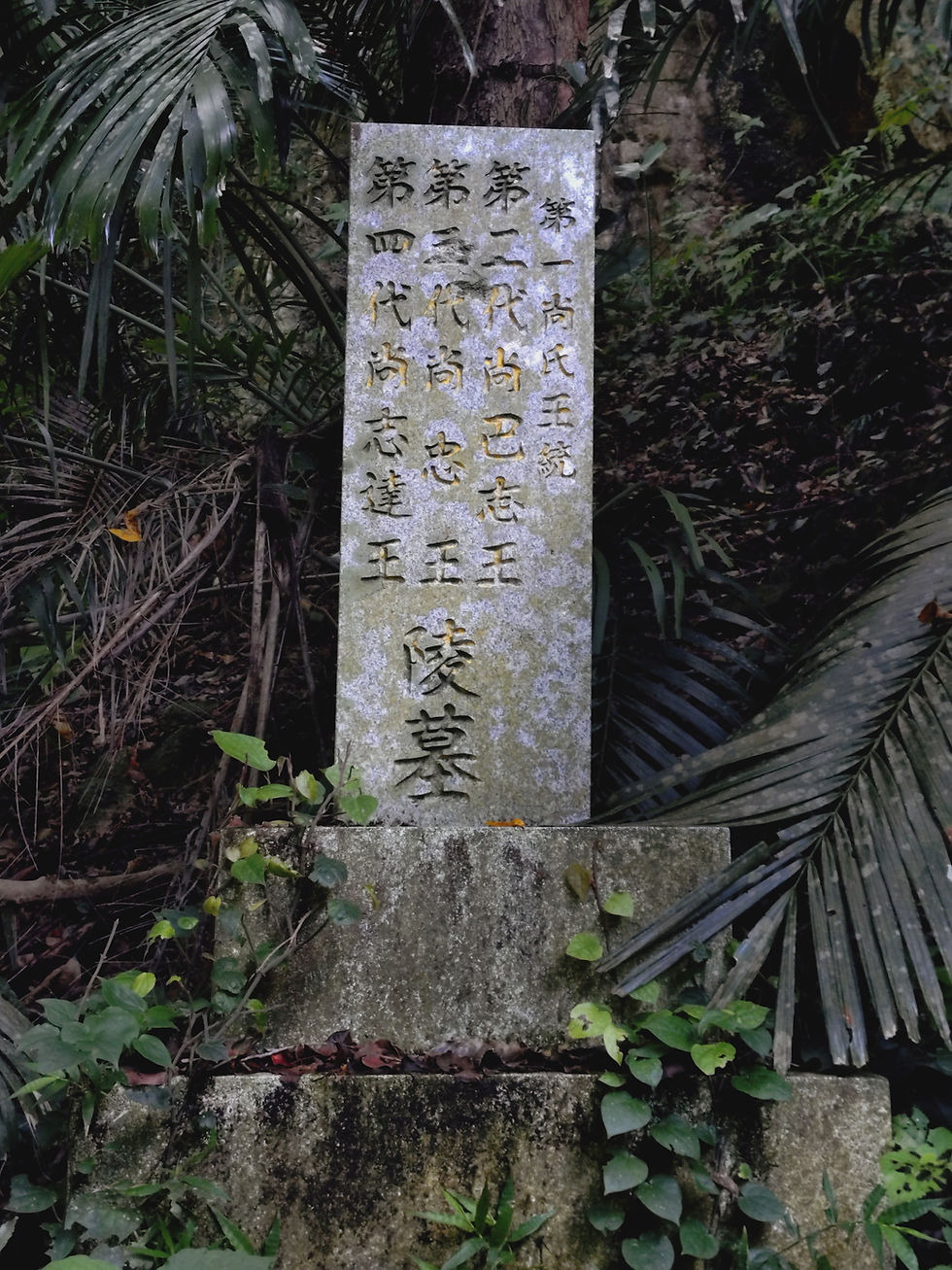
The remains of Sho Hashi, Sho Chu and Sho Shitatsu, the first three kings of the First Sho Dynasty eventually were enshrined in a forest in the Iramina area of Yomitan, where you can still visit them today. The tombs of the other kings of the First Sho Dynasty currently stretch from Urasoe City to Nanjo City. Although there have not been archeological digs to definitively answer who is in the tomb in Iramina, the area has been traditionally called Sashichimui, meaning the forest of Sashiki, in reference to Sashiki, Nanjo City which was originally Sho Hashi’s home base. Additionally, nearby the Sho Family tomb, you can also find the tombs of Hirata-ko, the oldest son of Sho Hashi and Yabiku, the third son of Hirata-ko and a grandson of Sho Hashi. Based upon these tomb placements, we can assume that these families originally rescued the bones of Sho Hashi and his descendants and placed them by their own tombs. I visited during April just after shimi, the grave-sweeping festival, and I could see that their families still visit these graves today to pay their respects to their ancestors.

Even though Okinawa is a small island and the Ryukyu Kingdom was never a powerhouse in world affairs, there are still a ton of intriguing stories and history to be uncovered and experienced. I hope you visit Okinawa and explore because the island is so much more than blue skies and beautiful beaches. Better yet, take a tour with me and find out how much more there is to Okinawa beyond being Japan’s Hawaii.
A lot of my research for this post was taken from various curator column’s written by curators at the Okinawa Prefectural Museum and Art Museum. They offer a lot of interesting posts and occasional presentations, so I highly recommend checking out their website, even if you can’t make it to the actual museum: https://okimu.jp/museum/column/
***Side Note: There are some major problems with the official histories of the Ryukyu Kingdom, particularly those that record events prior to the sixteenth century. The earliest official history was written in 1650, so most of the Ryukyu’s history before this date, is based upon oral traditions. Additionally, at the time when the early histories of the Ryukyus were be written morality shaped many of the historical facts recorded. Kings who lost their position, such as Sho Toku, did so because of some type of moral deficiency, while kings who won their positions, such as Sho En, did so because they were morally upright, clearly shaping the way that future generations remember their reigns. Therefore, there are numerous interpretations regarding the reigns of the earliest kings of the Ryukyus and depending on what you read, others might come to different conclusions.


Comments